
A scooter can be a great vehicle for an active lifestyle, but buying used takes extra care. A clean-looking scooter can still have paperwork problems, mismatched IDs, or a suspicious history.
One practical step is to locate the scooter's identifier (often a 17-character VIN in North America, or a frame/chassis number in other cases), decode it, and compare it to the title/registration and bill of sale. Decoding is a starting point; a history check (when available) adds context.
Scooter and Moped VIN
Depending on the vehicle and how it is classified where it is sold/registered, a scooter or moped may have a standard 17-character VIN, or it may have a shorter manufacturer serial (often called a frame/chassis number).
When You Have a 17-Character VIN
In the United States, most street-legal scooters and mopeds that are titled/registered for on-road use use the standardized 17-character VIN. Federal rules define the VIN as 17 characters and require a check digit in position 9.
For a 17-character VIN, the structure is:
- WMI (1-3): World Manufacturer Identifier
- VDS (4-9): Vehicle Descriptor Section
- VIS (10-17): Vehicle Identifier Section
In this format, position 10 often encodes the model year, position 11 commonly indicates the assembly plant, and positions 12-17 are typically the production sequence number.
Why Your Scooter or Moped ID Might NOT Be 17 Characters
Non-17 identifiers are common in a few specific situations. In these cases, you will usually be working with a frame/chassis number (or a state-assigned VIN), not a modern 17-character VIN.
| Situation | What You May See | Why It Happens | What To Do |
|---|---|---|---|
| Vintage / pre-1981 | Shorter serial number (varies by maker) | Older vehicles were not built under the modern 17-character VIN standard | Use the frame/chassis number to match paperwork; decoding may be limited |
| Market-specific or imported model | Non-17 chassis number or unusual format | Different markets used different numbering systems; compliance/markings can vary | Verify stamp quality and document match; use manufacturer or official verification when possible |
| Assembled from parts / converted motorized bicycle | No VIN, or a basic frame serial only | Homemade/converted builds may not have a manufacturer-assigned VIN | Registration may require an assigned VIN or decal from the state |
| State-issued VIN | Assigned VIN label/decal or state number | Some states will assign a VIN when a registrable moped/scooter lacks one | Follow your state DMV process for VIN assignment before licensing/registration |
If manual decoding feels like a rabbit hole, an online decoder is usually faster and less error-prone. Just remember: decoding explains what the identifier means; it does not automatically prove title status or history.
VIN vs. Frame/Chassis Number
Scooters and mopeds often have multiple stamped or printed identifiers. The most common mix-up is entering an engine number or a frame/chassis number and expecting it to decode like a 17-character VIN.
| Identifier You Have | Typical Look | Where You'll See It | What It's Used For |
|---|---|---|---|
| VIN (17 characters) | 17 letters and digits (no I, O, Q) | Label/plate and/or a frame stamp | Decoding basic attributes; matching to paperwork; running history checks where data is available |
| Frame/Chassis Number | Can be shorter, may include prefixes | Stamped into the frame (often hidden by body panels) | Legal identity in many markets; must match the registration documents |
| Engine Number | Separate code on the engine case | Stamped on the crankcase/carter | Service, parts, and verification; not a VIN substitute |
If your code is not 17 characters, don't assume it's invalid. Many mopeds, older scooters, and some market-specific models use non-17 formats.
Where to Find the VIN on a Scooter or Moped
On many scooters, the VIN/frame stamp is easy to miss because it's behind plastic panels. Use a flashlight and take your time.
| Scooter/Moped Type | Most Common VIN/Frame Locations | Quick Tip |
|---|---|---|
| Modern step-through scooter | Under the seat (under-bucket area), center tunnel/floor area, steering neck (head tube) | You may need to remove the under-seat bucket (usually a few screws) |
| Vintage/classic scooter | Frame stamp behind a side cover/cowl or near the engine side of the frame | Look for a clean, factory-style stamp with consistent depth |
| Small moped | Near the steering head, down tube, or footrest area | Clean gently; avoid over-sanding or damaging paint |
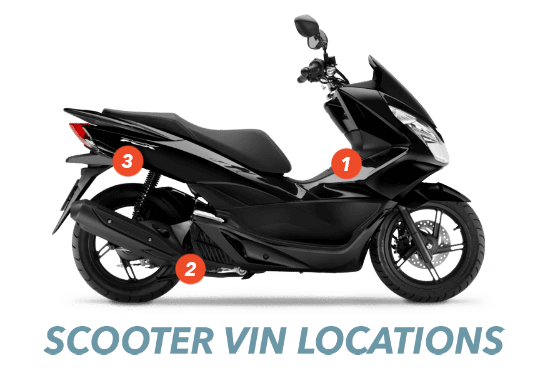
Always compare:
- The VIN/frame number on the vehicle
- The number on any VIN label/plate (if present)
- The number printed on the title/registration and bill of sale
What a VIN Decoder Can and Can't Tell
A decoder helps you validate the format and understand what the identifier says about the vehicle. A history report can add vehicle-level context, when records exist.
| Question | VIN Decoder | VIN History Report |
|---|---|---|
| Is the code a valid VIN format? | Yes (format checks, check digit where applicable) | Usually includes the VIN as the primary key |
| Who made it / what is it? | Often yes (manufacturer, attributes based on VIN) | May confirm and add context from records |
| Model year (if the market uses the standard year code)? | Often yes (depends on region/standard) | May confirm via registrations, inspections, or other records |
| Was it stolen, salvaged, or in a major loss? | No (not encoded in the VIN) | Sometimes (depends on reporting/coverage) |
| Accidents, title brands, auction, mileage flags, recalls | No | Sometimes (depends on the specific record type and data availability) |
A decoder can flag inconsistencies (for example, the decoded make doesn't match the seller's claim). A history report can help you spot red flags, but it still can't guarantee a scooter is problem-free.
Classic and Imported Scooters
With vintage scooters (and many imported models), you may see:
- An identifier format that's shorter than 17 characters
- Manufacturer prefixes or separators
- Separate frame and engine numbers used for verification
For classics and imports, verify the identifier format for that model and compare the frame stamp quality with other factory markings.
Common WMI Prefixes for Scooters and Mopeds in North America
The first 3 characters of a VIN are called the WMI (World Manufacturer Identifier). It is a quick way to spot who built the scooter or moped and (often) where it was produced. A single brand can have multiple WMI prefixes depending on the factory and country, so treat this list as a practical reference - not a complete catalog.
| Brand | Common WMI Prefixes | What It Usually Indicates |
|---|---|---|
| Honda | JH2, 1HF, RLH, MLH, LAL, LWB | Honda scooters/mopeds built across multiple plants (Japan, USA, Vietnam, Thailand, China) |
| Yamaha | JYA, 5Y4 | Yamaha scooters/mopeds (Japan and some other production sources) |
| Suzuki | JS1, JSK, DL1 | Suzuki scooters/mopeds and motorcycles (commonly Japan; WMI varies by plant) |
| Vespa (Piaggio Group) | ZAP | Piaggio/Vespa scooters (Italy) |
| Aprilia (Piaggio Group) | ZD4 | Aprilia (Piaggio) bikes/scooters (Italy) |
| KYMCO | RFB, LC2 | KYMCO built in Taiwan (RFB) or China (LC2) |
| BMW Motorrad (Scooters) | WB4, WB1 | BMW scooters are commonly built in China (WB4); some BMW products use WB1 (Germany) |
| Genuine Scooters (US brand) | LAN | Genuine-branded scooters built by Changzhou Yamasaki (China) for US distribution |
Helpful Resources
- 49 CFR Part 565 - VIN Requirements – Federal VIN format and content rules.
- 49 CFR 571.3 - Definitions (Motorcycle, Motor-Driven Cycle) – Key federal definitions for vehicle classes.
- NHTSA Manufacturer Handbook (VIN, WMI, Labels) – VIN/WMI guidance with examples.
Frequently Asked Questions
How Long Is a Scooter or Moped VIN?
Where Is the VIN on a Scooter?
How Can I Tell What CC a Moped Is?
Is the VIN the Same as the Engine Number?
Was this page helpful?