
A used motorcycle can look perfect from 10 feet away and still be wrong on paper. That is why the VIN should come early, before the bike starts looking like it already belongs in your garage.
At FAXVIN, we treat a motorcycle VIN decoder as the first filter, not the final verdict. A free lookup can confirm the bike's basic identity. A full history report can help you review the risk behind it: title events, theft indicators, reported mileage, recalls, salvage or rebuilt branding, auction records, and other available history signals.
Neither replaces a physical inspection. A database cannot feel fork play, hear an engine knock, or spot a tired chain. But it can keep you from buying someone else's headache with handlebars.
FAXVIN has been helping vehicle owners and buyers check records since 2010. Our job is not to turn every bike into a mystery novel. It is to make the important details easier to verify before money changes hands.
What a Motorcycle VIN Decoder and Lookup Actually Does
A motorcycle VIN decoder turns the Vehicle Identification Number into usable identity data. For most U.S.-market motorcycles built from 1981 forward, that means a standardized 17-character VIN tied to the manufacturer, model year, model line, plant information, and other maker-encoded details.
A VIN lookup goes beyond identity. It searches available records connected to that motorcycle, which may include title brands, odometer readings, theft indicators, total-loss signals, registration activity, recalls, service or inspection entries, auction information, and other reported events.
The distinction matters. A decoder answers, "What is this motorcycle supposed to be?" A history lookup answers, "What has been recorded about it?"
Together, they help separate simple listing errors from problems that deserve a closer look.
Why the VIN Matters Before You Buy, Sell, or Register
Most riders check a VIN when buying used. Good. That is when one bad assumption can get expensive.
If you are buying, the VIN helps flag the classic traps: theft, salvage or rebuilt history, odd mileage, or paperwork that does not match the frame. A polished tank and loud exhaust do not fix a title problem. Chrome is not paperwork. Sadly.
If you are selling, a VIN lookup can answer serious buyer questions early. Clean records can smooth the sale. Branded title history is better handled directly than discovered later.
If you are registering or insuring a motorcycle, the frame VIN must match the title, registration, and supporting documents, especially with auction bikes, out-of-state purchases, imports, older units, and private-party sales.
A proper motorcycle VIN check helps reduce four common risks:
- Identity risk - the bike is not the exact year, model, trim, or configuration the seller claims.
- Title risk - the title is branded, inconsistent, washed through another jurisdiction, or tied to a complication.
- Condition risk - the motorcycle has reported damage, a total-loss event, mileage issues, or an auction trail that changes its real value.
- Legal risk - the bike may be stolen, improperly documented, hard to register, or difficult to insure.
What You Can Learn From a Motorcycle VIN
A motorcycle VIN gives you identity data and, through available records, history context. It can confirm the make, model, model year, manufacturing origin, production details, and other specifications. That matters because fairings, tanks, graphics, engines, and seller descriptions can all change.
When available, a full report may show salvage, rebuilt, junk, or flood title brands; odometer readings; theft or recovery indicators; prior registration states; recalls; lien-related signals; total-loss records; service or inspection entries; and auction activity.
Use the VIN to test the seller's story against records. A clean result still does not prove a perfect bike. Some crashes, repairs, older motorcycles, and off-road use leave little or no digital trail.
Where to Find the VIN on a Motorcycle
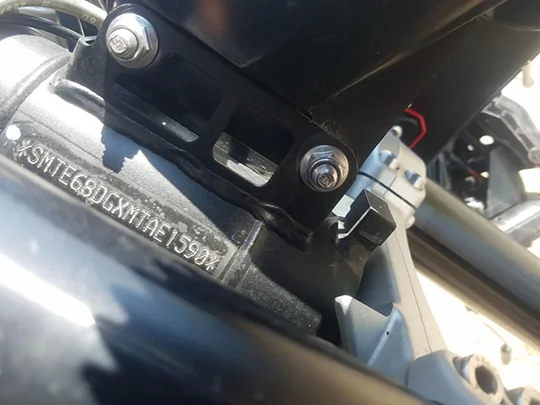
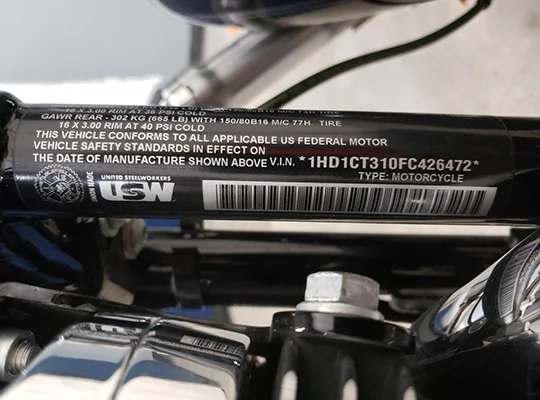
Start at the steering neck or headstock near the front forks. Turn the handlebars, use a flashlight, and look for the stamped frame VIN or manufacturer plate. You may also find a VIN label on the frame, under the seat, near the engine area, or on documents such as the title, registration, insurance card, and bill of sale.
Do not treat every number on the bike as the VIN. Engine numbers can help with parts research or extra verification, but the legal check usually starts with the frame VIN and matching paperwork. If the seller points you to the engine number instead, slow down.
Common starting points include:
| Motorcycle Area | What to Check | Why it Matters |
|---|---|---|
| Steering neck / headstock | Stamped VIN or VIN plate | Most common frame VIN location on many motorcycles |
| Frame rail or frame plate | Manufacturer label or secondary VIN location | Useful when the steering neck area is hard to access |
| Under-seat area | VIN label or model information | Common on some bikes, scooters, and off-road models |
| Title and registration | Exact VIN match | Confirms whether the paperwork belongs to the frame |
| Insurance card / bill of sale | Supporting VIN match | Helps catch typos or document inconsistencies |
| Engine case | Engine number or secondary marking | Helpful context, but not a replacement for the frame VIN |
Here is a quick brand guide. Treat the prefixes as examples, not a complete list. VIN prefixes can vary by market, factory, model year, and production source.
| Brand | Common VIN Location | WMI |
|---|---|---|
| Honda | Steering head area | JH2 MLH RLH |
| Yamaha | Head tube or steering head; sometimes engine-area marking | JYA MH3 RKR |
| Suzuki | Right side of steering head or frame area | JS1 VTT GS7 |
| KTM | Steering head tube, frame plate, or sometimes under-seat area | VBK MD2 LCE |
| Harley-Davidson | Frame near the steering head; some models also show related numbers elsewhere | 1HD 5HD MLY |
| Kawasaki | Right or left side of the steering head; on some models also on the main frame near the engine or under the seat | JKA JKB ML5 |
| BMW | Frame, front right, or steering head; location varies by series | WB1 WB3 WB4 |
Inspect the VIN area closely. Fresh paint, grinding marks, uneven stamping, crooked characters, odd rivets, new welds, or a too-new plate should slow the deal down fast.
Free Motorcycle VIN Lookup vs. Full History Report
A free motorcycle VIN lookup is best for early screening. It can confirm that the bike matches the listing and may show whether deeper history is available. Useful when you are comparing several bikes and need to cut obvious mismatches fast.
A full history report is for a serious candidate, when those signals deserve context instead of a quick glance.
Here is the clean split:
| Check Type | Best For | Usually Helps With | Limits |
|---|---|---|---|
| Free motorcycle VIN lookup / decoder | First-pass screening | VIN validation, year, make, model, trim, engine or basic specs when available | Usually not enough for final buy/no-buy decisions |
| Full motorcycle history report | Risk review before purchase, sale, registration, or insurance | Title brands, theft indicators, odometer events, recalls, auction/service records, registration activity, and other reported events where available | Does not prove current mechanical condition or repair quality |
Use the free lookup to decide whether the motorcycle deserves more attention. Use the full report when money, risk, or uncertainty starts to climb.
A full report is especially useful for bikes priced suspiciously low, sold with weak private-party documentation, coming from auction, advertised as rebuilt or salvage, older but valuable, imported, out of state, or likely to be registered and resold soon.
How to Check a Used Motorcycle Before You Commit
Start with the VIN, not the seller's story. Before you visit, get the VIN and a clear photo of the VIN area. A refusal is a warning sign.
In person, make the frame, paperwork, and records tell the same story. Inspect for tampering or crash signs. Question odd mileage entries, especially on digital odometers, where tampering can be hard to spot visually. Price title brands accordingly.
Here is the practical sequence we recommend:
- Get the VIN and a photo of the frame VIN area.
- Run the free lookup to confirm the motorcycle's basic identity.
- Compare the decoded result with the listing and seller claims.
- Match the frame VIN to the title, registration, insurance card, and bill of sale.
- Order a full history report if the bike is a serious candidate or any part of the deal feels off.
- Inspect the motorcycle in person for crash signs, tampering, parts swaps, corrosion, leaks, and poor repairs.
- Compare the records, paperwork, physical bike, and seller story.
- Walk away if the important pieces do not line up.
Red Flags That Should Change the Deal
Some problems deserve questions. Others deserve a hard stop. The trick is knowing which is which.
A paperwork typo can happen. A VIN that does not match across the frame and title is different. A sparse record can be normal for an older dirt bike. A seller pushing you to ignore mismatched documents is not normal. A rebuilt title can be acceptable at the right price with proper repair evidence. A rebuilt motorcycle with no repair paperwork and a vague story is a gamble.
This is where title fraud gets ugly. Title washing can hide or blur a brand as a vehicle moves between jurisdictions. VIN cloning can put a stolen motorcycle under another vehicle's identity. Odometer rollback makes mileage look lower than it is. Different tricks, same lesson: inconsistencies matter.
Watch for these deal-changing signals:
| Red Flag | What it May Mean | Best Move |
|---|---|---|
| Frame VIN does not match title | Wrong title, clerical issue, fraud, or swapped frame | Stop and verify before paying |
| VIN decodes to a different year or model | Listing error, frame swap, bad paperwork, or seller deception | Ask direct questions and verify deeper |
| Fresh paint, grinding, odd rivets, or uneven stamping near VIN | Possible tampering | Walk away or involve proper authorities |
| Seller refuses to provide VIN before meeting | They may not want scrutiny | Treat as high risk |
| "No records found" presented as "clean history" | Thin data being oversold | Inspect more, not less |
| Mileage does not match wear level or records | Odometer issue, replacement cluster, or weak story | Ask for proof and price the risk |
| Rebuilt or salvage bike with no repair records | Unknown damage quality and resale risk | Demand documentation or move on |
| Seller pressures for quick deposit before verification | Rushed sale, scam risk, or hidden issue | Do not reward pressure tactics |
Special Cases: Dirt Bikes, Older Motorcycles, Imports, and Branded Titles
Not every motorcycle leaves the same paper trail. Category matters.
Dirt bikes and off-road motorcycles
Modern dirt bikes often have VINs, but records can be thin. Many change hands privately, get used hard, and may never be titled like road bikes. Focus on identity, theft risk where available, any title or bill of sale, and frame condition.
Older motorcycles
Pre-1981 motorcycles may use shorter identifiers, so automated decoding and public records can be limited. Some older bikes also carry engine-number history; in certain state processes, a bike registered only by engine number may need a frame number assigned before registration. Not universal, but worth taking seriously.
For older bikes, lean on frame-number verification, title matching, manufacturer references, model-specific documentation, service history, and careful inspection. Thin records can be legitimate. Thin records plus ignored mismatches? Different story.
Imports and grey-market bikes
Imported motorcycles can bring non-standard labels, incomplete U.S. records, and paperwork that does not fit neatly into DMV expectations. Verify the title, import documents, and exact model specification. Also watch the age lines: NHTSA's 25-year FMVSS treatment and EPA's separate 21-year emissions framework are not the same thing.
Rebuilt, salvage, and branded-title motorcycles
Branded-title motorcycles can be good buys only when the discount is real and the damage story is documented. Appearance alone is not enough. Branded history can affect resale value, insurance, financing, registration, and buyer confidence later. Before buying salvage or rebuilt, get an insurance quote, inspect the frame, and make sure the title status works in your state.
Helpful Motorcycle VIN Resources
- MSF T-CLOCS Checklist – motorcycle inspection checklist.
- NICB Motorcycle Theft Guide – theft prevention and ID tips.
- California DMV VIN Plate Assignments – frame and engine-number guidance.
Frequently Asked Questions
Can I check a motorcycle VIN for free?
What if my motorcycle VIN has fewer than 17 characters?
Should I compare the engine number to the VIN?
Do dirt bikes have VINs?
Was this page helpful?