California License Plate Lookup

Know the Facts Before Buying – Check California License Plates

Example: 9CBB916 (CA)

A California license plate lookup pulls vehicle-level details from a plate number – make/model/year and, with a full report, key risk signals like title brands, damage, theft, liens, recalls, and mileage issues.

Use it before buying or selling to verify the vehicle and reduce surprises.

FAXVIN offers both a free California plate lookup and a paid report. The free report focuses on basic vehicle identification and specs. The paid report adds vehicle history – including ownership signals, accidents/damage, title brands, theft, recalls, liens, and more.

Our free California license plate lookup includes a few key data points:

  • Vehicle Identification Number (VIN): Use the plate to uncover the VIN (often missing from listings). Then confirm it matches the VIN shown on the vehicle (windshield/door-jamb label) before you run a full history search.
  • Vehicle Attributes: Basic specs like make, model, year, body style, engine, and age.
  • Check Digit Verification: Confirms whether the VIN structure is valid.

We also offer a free VIN lookup. It doesn't include history, but it can show more specs and, where available, MSRP data sourced from manufacturers.

Try out our California license lookup! Simply enter this sample CA plate (5CQ7102 CA) to see the information you'll get once you use the tool.

To reduce risk when buying used, upgrade to a paid report to review the vehicle's history and red flags. Depending on availability, it can include:

  • Accidents or damages: Crash and damage entries (including vandalism or weather events), plus salvage/total-loss details.
  • Title status check: Branded titles such as Salvage/Rebuilt, Junk, Lemon buyback, Water Damaged, Scrapped, Replica, or Totaled. (Title)
  • Odometer & mileage signals: Mileage reported over time, plus rollback-related patterns.
  • Theft & recovery records: Stolen/recovered history.
  • Recalls & defects: Open (unrepaired) safety recalls (generally up to 15 years via NHTSA).
  • Lien & repossession records: Possible liens/loan collateral flags and repossession-related records.
  • Service/inspection/registration events: Reported maintenance and registration-related entries where available.
  • Sales records: Past sale/auction listings reported by dealers, auctions, and other sources.
  • Ownership signals (where available): Indicators such as prior-use patterns (e.g., fleet/service) and other ownership-related fields.

Odometer fraud remains a serious problem in the used car market. NHTSA estimates that more than 450,000 vehicles are sold each year with false odometer readings. On average, buyers can lose over $4,000 per vehicle.

For deeper risk checks, use the paid report – plus a FAXVIN CarRank score to compare vehicles.

Source of Records

As far as the CA license plate number lookup and reverse plate lookup services are concerned, we use a variety of sources to build reports:

  • Manufacturers
  • Car Dealerships
  • State Inspection Stations
  • U.S. Motor Vehicle Title System (NMVTIS)
  • Canadian Motor Vehicle Agencies
  • Salvage Auctions
  • Auto Auctions
  • Insurance Companies
  • Rental/fleet Vehicle Companies
  • Collision Repair Facilities
  • The National Highway Traffic Safety Administration
  • Other industry partners

We combine data from multiple sources to provide the most complete report available. Coverage varies by vehicle and reporting partners.

Some accidents and damages may go unreported. Always perform a mechanical inspection with the help of a qualified technician.

Plate Design, Formats and Options

Personalized California License Plate Design

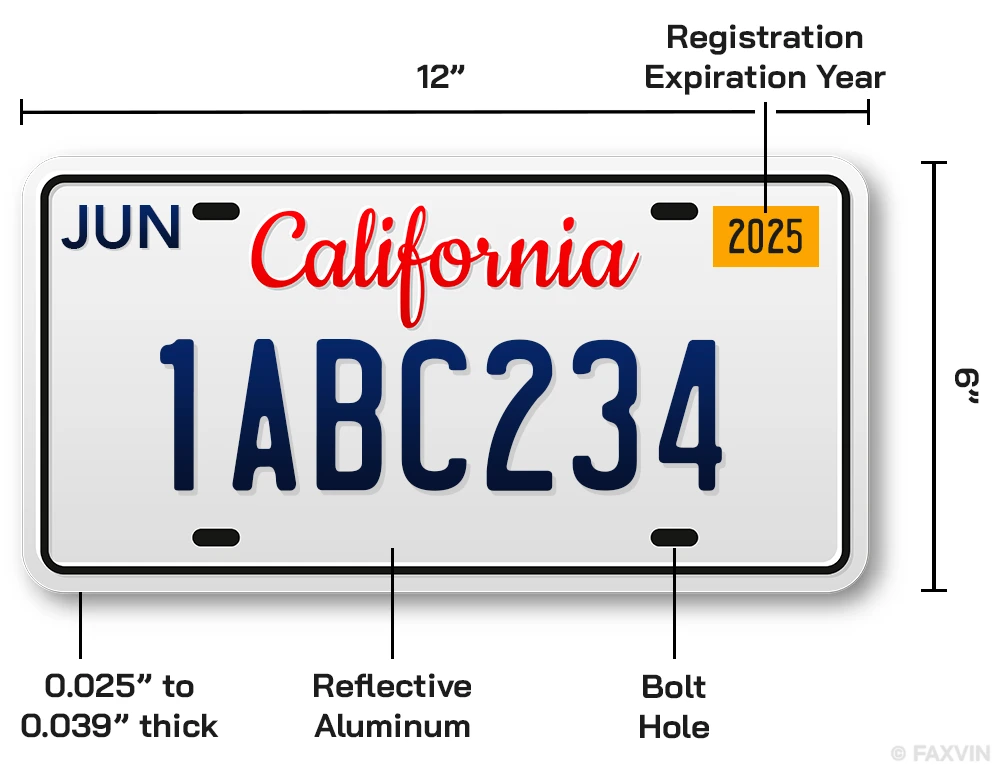
California plates come in multiple programs and designs. The standard plate features "California" in red script on a white background with blue characters.

Format and Serialization

Since 1980, California has used a seven-character format for its standard license plates, which begins with a number, followed by three letters, and ends with three numbers (for example, 1ABC123).

Why You Rarely See I, O, or Q on CA Plates

California's standard passenger plates are designed to be easy to read quickly–by people and by license-plate recognition systems. Letters like I, O, and Q can be mistaken for 1 and 0 (or for each other) in certain fonts, lighting, angles, or low-resolution photos.

To reduce errors, California limits where these letters can appear in the common 1ABC123 pattern: I, O, and Q are not used as the first or third letter in the three-letter block. You may still see them only as the middle letter (the second letter) in that block.

Quick tip when typing a plate: in the standard format, positions 1, 5, 6, 7 are numbers, and positions 2, 3, 4 are letters. So if you're unsure whether a character is O vs 0 (or I vs 1), first check whether it sits in a letter position or a number position. (Personalized and some specialty plates can follow different rules.)

What Happens After 9ZZZ999? The Next CA Serial Format

California's standard passenger plates follow a sequential series. The 1ABC123 pattern runs through combinations until it reaches the end of the cycle (often summarized as 9ZZZ999). When that happens, California does not "reset" back to 1AAA000–instead, it shifts to a new serial pattern.

The next planned standard passenger format is 000AAA0 (three numbers, three letters, then one number). In other words, it's a "mirror-image" layout compared to 1ABC123.

  • You may start seeing plates that look like 000ABC1. That's normal for newer issues once the state transitions formats.
  • Older formats remain valid–this change is about issuing new serials, not invalidating existing plates.
  • When entering a plate, use the pattern as a sanity check: NNNLLLN vs NLLLNNN (standard passenger plates). Personalized and some specialty plates can differ.

California Passenger Plate Serial Formats by Era

The timeline below summarizes standard passenger formats only. Specialty, dealer, and organizational plates may use different serial rules.

Period Serial format Notes
1963 – 1969 ABC123 Black base. Six-character passenger serials (letters + numbers).
1970 – 1980 123ABC Blue base. Six-character passenger serials (numbers + letters).
1980 – present 1ABC123 Seven-character passenger serials (leading digit + 3 letters + 3 numbers).
Next (after 9ZZZ999) 000AAA0 Planned "mirror-image" reversal: 3 numbers + 3 letters + 1 number.

Laws and Regulations

Most passenger vehicles use two plates (front and rear), with tabs/stickers typically on the rear plate. Some vehicle types (such as motorcycles) are rear-only. For practical visibility/cover rules, see Front Plate Rules below.

Did you know that since 1947, inmates at Folsom State Prison have produced all the plates used in California?

Special Interest Plates

Beyond the standard issue, California offers various special interest plates. These designs can support causes and organizations, while legacy plates recreate styles from earlier decades.

Disability Tags

California offers disabled-person and disabled-veteran plate/placard programs for eligible residents. See the DP/DV section below for the most common markings you'll see in listings.

Vanity License Plates

Personalized or vanity plates let you create a distinctive combination of letters and numbers. You can select a custom sequence limited to six or seven characters, depending on plate type and spacing. Examples include custom messages, names, or initials.

Understanding California Registration Stickers

Registration stickers show the expiration month and year. On standard passenger plates, the month tab is typically placed in the sticker well left of "California," and the year tab in the well right of it–usually on the rear plate.

Buyer check: match the sticker date to the registration paperwork and watch for obvious tampering (peeling edges, mismatched tabs, or signs of re-application).

Fast options: renew through official DMV channels; some kiosks/approved partner locations can print stickers immediately. Lost tabs or registration cards can be replaced through DMV replacement flows.

Front Plate Rules

Most passenger vehicles are issued two plates (front and rear). If only one plate is issued for a vehicle type, it's typically displayed on the rear.

Plates and tabs must be clearly visible and legible. Avoid:

  • Tinted/reflective covers
  • Frames that block the state name, plate number, or tabs/stickers
  • Dirt, damage, or films that reduce readability
  • Any flipper/obscuring device

Buyer tip: If the front plate is missing, ask why and confirm the seller has the second plate and bracket/hardware.

Lost, Stolen, or Damaged Plates

Use the DMV for replacements–don't drive with a homemade plate.

  • If stolen: file a police report (recommended) and request replacements through the DMV.
  • What you can replace: plates, stickers/tabs (month/year), and the registration card.
  • Fast options: replacement tabs/registration cards can often be requested online; some kiosks/approved partners can print items on the spot.
  • Plates: replacing plates typically requires an application (commonly REG 156) and a fee; requirements can vary by plate type, and current registration may be required.

Buyer tip: "Lost/stolen plates" should trigger a paperwork check–verify registration status and match the VIN on the vehicle to the title/registration.

Special Interest vs Special License Plates vs Personalized

These terms describe different things: the design/program of the plate versus the characters printed on it.

  • Special interest plates: Plates with themed designs that support specific causes or organizations. They're available to most drivers and usually come with additional fees.
  • Special license plates: A broader umbrella for non-standard plate programs issued by the DMV (including special interest designs and other categories that may have specific rules or eligibility requirements).
  • Personalized (vanity) plates: A custom letter/number combination you choose. Personalization is an option that can apply to many plate types (standard or some special programs), subject to availability and DMV approval rules.

Quick way to think about it: Special interest / special license = what the plate is; personalized = what the plate says.

What DP/DV/EXEMPT Plates Mean

When you're browsing listings or looking at plate photos, you may see markings that indicate the plate type, not the owner's identity.

  • DP (Disabled Person): Issued for vehicles registered to a qualified permanently disabled person (or certain organizations that transport disabled persons). DP plates are tied to disabled parking eligibility, but parking rules can vary by city/location.
  • DV (Disabled Veteran): Issued to eligible disabled veterans. In some situations, a DV plate holder may also need a DP placard to receive specific parking privileges.
  • EXEMPT / CA EXEMPT: Used for vehicles under an exempt classification (commonly government-related). These plates signal the vehicle is treated differently for registration/fee purposes.

Why it matters to buyers: a special plate type can hint at prior use (for example, government fleet) and may explain why a plate doesn't match standard passenger formats. It still doesn't provide personal owner information.

CA Ownership History

A California license plate lookup report may include ownership-related signals, such as the total number of previous owners (where available), plus when and where the vehicle was first purchased and later resold. This can also hint at rental or fleet history, which may affect wear and tear.

A California license plate lookup can help you review vehicle-level information that may be available from vehicle-history sources. It cannot be used to obtain the registered owner's identity.

Under the Driver's Privacy Protection Act (DPPA) and related privacy rules, personal data from DMV records is restricted. This means you won't see the owner's name, address, phone number, or driver license/ID number.

DMV Record Requests and Privacy

A vehicle-history report uses vehicle-level sources. An official DMV record request may include personal data, so access is restricted by DPPA and California rules.

If you have a DPPA-permitted reason, California DMV provides a formal request process (commonly via INF 70). You typically must certify a permissible use, provide the identifiers needed to locate the record, and pay a fee. Requests can be denied if the purpose doesn't qualify.

Common permissible-use categories include government/law enforcement, court proceedings, insurance claims/fraud work, certain safety/theft functions (with limits), and lienholder/towing notifications (where applicable).

How to Use This Information

When buying a used car, the California license check can help you verify condition, paperwork, and risk signals:

  • Confirm the seller can sell: match the VIN on the vehicle to title/registration and verify lien release.
  • Scan for undisclosed modifications: safety, legality, and emissions issues.
  • Verify model year/trim: helps pricing, insurance quotes, and maintenance planning.
  • Cross-check mileage: compare history entries to the odometer to spot inconsistencies.
  • Use exact make/model/engine: for parts, recalls, and service bulletins.
  • Check prior registration origin: out-of-state/country history can affect value and compliance.

Note that FAXVIN does not modify or change source data as part of our California license plate lookup service. We make our best effort to compile vehicle-level information from U.S. and Canadian sources–always verify the VIN on the vehicle and get a mechanical inspection before you buy.

Don't delay checking your California license online. It can save you a lot of hassle from buying a car with hidden defects that waste time and money.

Smog Check Basics for California

In California, a Smog Check is often part of a used-car purchase–especially during a change of ownership.

When you buy from a private seller: the vehicle generally must have passed a Smog Check within the last 90 days, and the seller should give you a copy of the Vehicle Inspection Report (VIR).

When you buy from a dealership: the vehicle generally must have passed a Smog Check within the past two years.

Common exemptions:

  • Gasoline/hybrid/alternative-fuel vehicles that are 4 model years old or newer (transfer may still involve a DMV smog transfer fee).
  • Electric vehicles.
  • Gasoline vehicles model year 1975 or older.
  • Diesel vehicles model year 1997 or older, and diesel vehicles with a GVWR over 14,000 lbs.
  • Motorcycles.

Quick buyer tips:

  • A vehicle typically won't pass if the check engine light is on.
  • Verify the VIR date and keep a copy with your paperwork.
  • If you want extra confidence, you can check the vehicle's smog inspection history through official channels.

Additional Resources

Frequently Asked Questions

Can A Vehicle History Report Be Obtained With A California License Plate Number?

Yes. With FAXVIN, you can start with a free California plate lookup to get basic vehicle identification (often including the VIN) and core specs. Then, use the paid report to review vehicle history such as title brands, accidents/damage, theft, liens, recalls, mileage signals, and ownership-related indicators where available.

What Is The Process For Registering A Vehicle And Getting A CA License Plate?

It depends on how you bought the vehicle. If you purchased from a California dealer, the dealer typically submits registration/title paperwork for you. For private-party purchases, out-of-state vehicles, or special cases, you generally submit an Application for Title or Registration (REG 343), proof of ownership (title and related documents), pay fees/taxes, and meet California requirements such as Smog Check where required and valid financial responsibility (insurance).

Do You Need A Front License Plate In California?

If two plates are issued for the vehicle, California law requires one plate mounted on the front and one on the rear. If only one plate is issued for that vehicle type, it is typically displayed on the rear. Plates and registration tabs must remain clearly visible and legible—avoid covers or frames that obstruct the state name, plate number, or registration tabs; limited tab-only security covers may be allowed if they don't cover the plate number.

What Types Of California License Plates Are Available?

California offers standard plates, Special Interest plates (themed designs supporting causes/organizations), and Special License plates (programs tied to recognition, status, or specific categories). Personalization (vanity characters) may be available for many plate types, and there are also eligibility-based plates like DP/DV, plus other programs such as legacy-style plates and exempt classifications.

Are Old "Black Plates" Still Legal In California?

Yes – original black California plates can still be legal if they're valid plates assigned to the vehicle and the registration is current with proper tabs/stickers. California also offers a DMV "Legacy" program that lets many vehicle owners order replica black plates. What's not legal is repainting or altering a standard plate to look like a black plate.