
Every 17-digit Vehicle Identification Number contains specific factory build details encoded by the manufacturer. Our tool instantly extracts this data, verifies the check digit for VIN validity, and translates raw option codes into a clean specification sheet.
What You Get from Our Free VIN Decoder
We provide up to 120 accurate vehicle attributes from direct OEM data. We divide these factory specs into four major categories to help you quickly assess the vehicle’s actual build, capabilities, and original safety equipment.
General & Build Profile
- Model Year, Make & Model
- Exact Trim Level & Body Style
- Assembly Plant, City & Country
- Original Base MSRP
- Manufacturer & Corporate Details
Engine & Drivetrain
- Engine Type & Displacement (L/CC)
- Net Horsepower & Torque Specs
- Transmission Type & Speeds
- Drive Type (FWD / RWD / AWD / 4WD)
- Fuel Type & Injection System
Weights & Capacities
- GVWR (Gross Vehicle Weight Rating)
- Curb Weight & Payload Capacity
- Maximum Towing Capacity
- Wheelbase & Cargo Volume
- Original Tire Size & Wheel Specs
Safety & ADAS Features
- Airbag Locations & Restraint Types
- Anti-lock Brakes (ABS) & Stability Control
- Blind Spot Monitoring (BSM)
- Forward Collision Warning (FCW)
- Lane Departure Warning (LDW)
Free VIN Decoder vs. Full Vehicle History Report
A free decode will tell you how the car is built. A premium history report reveals where it went after it left the car dealership. The factory specs won’t tell you about hidden frame damage, title washing, or odometer fraud, but a thorough background check can help you find them.
| Data Included | Free VIN Decode Factory Specs & Basics | Full History Report Comprehensive Background Check |
|---|---|---|
| Factory Specs (Engine, Trim, Dimensions) | ✓ | ✓ |
| Original Safety Equipment (ADAS) | ✓ | ✓ |
| Open NHTSA Recalls | ✗ | ✓ |
| Severe Accidents & Collision History | ✗ | ✓ |
| Salvage, Junk, or Rebuilt Title Brands | ✗ | ✓ |
| Odometer Rollback Check | ✗ | ✓ |
| Theft & Recovery Records | ✗ | ✓ |
| Lien, Impound & Export Status | ✗ | ✓ |
| Insurance Total Loss Records | ✗ | ✓ |
What's Hidden in Your 17-Digit VIN?
Under NHTSA 49 CFR Part 565 and ISO 3779, a modern Vehicle Identification Number is not a random set of characters. It is a strictly formatted blueprint. This is how manufacturers encode a vehicle's specifications, and how our system decodes the data.
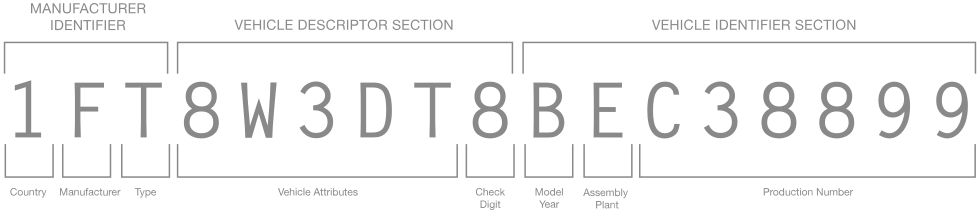
World Manufacturer Identifier (WMI)
The WMI tells you the country of origin, the manufacturer, and type of vehicle. But it also shows manufacturing anomalies and parentage. A BMW made in Germany begins with WBA, but a BMW assembled in the U.S. starts with 4US or 5UX.
- Position 1 (Country of Origin): Indicates the location of the final assembly. For example,
1,4, and5are USA,2is Canada,3is Mexico,Jis Japan, andWis Germany. - Position 2 (Manufacturer): Identifies the specific automaker.
- Position 3 (Vehicle Type): Combined with the first two characters, it classifies the vehicle's division (e.g., passenger car vs. commercial truck).
WMI Codes: Brand & Country
Selected, high-confidence WMI mappings. Use this as a quick guide; full assignments are maintained under SAE/ISO rules and can vary by vehicle class and plant.
| Manufacturer | Country | WMI | Manufacturer | Country | WMI | |
|---|---|---|---|---|---|---|
| BMW | Germany | WB1 WBA WBS WBX |
Honda | Japan | JH2 JH3 JHL JHM |
|
| Chevrolet | Canada | 2CN 2G1 2GC 2GN |
Honda | United States | 19X 1HF 1HG 478 5FN 5J6 |
|
| Chevrolet | United States | 1G1 1GB 1GC 1GN |
Lexus | Japan | JT6 JT8 JTH JTJ |
|
| Dodge | Canada | 2B3 2B6 2C4 2D4 2D8 |
Mercedes-Benz | Germany | WDA WDB WDC WDD |
|
| Dodge | United States | 1B3 1B4 1B7 1D4 1D8 |
Toyota | Japan | JT2 JT3 JT4 JTD JTE JTM JTN |
|
| Ford | United States | 1F6 1FA 1FB 1FC 1FD 1FM 1FT 1ZV |
Toyota | United States | 1NX 4T1 4T3 4T4 4TA 5TB 5TD 5TE 5TF 5YF |
Vehicle Descriptor Section (VDS)
The VDS contains the manufacturer’s homologation data, defining the core mechanical architecture and safety systems.
- Positions 4–8 (Vehicle Attributes): Indicate the particular body style, engine displacement, number of cylinders (e.g., I4, V6, V8), type of transmission and active restraint systems (airbags/seatbelts).
- Position 9 (The Check Digit): This is a critical security feature required by the U.S. Department of Transportation. It is a calculated value (0-9 or the letter "X") based on a complex mathematical algorithm applied to the other 16 characters. If the math doesn’t work, the VIN is invalid. This is the primary method to catch VIN typos and invalid character changes. This validation is done automatically by our decoder.
Vehicle Identifier Section (VIS)
The VIS is the vehicle’s unique serial number, showing exactly when and where it rolled off the assembly line.
- Position 10 (Model Year): A letter or number indicating the official model year (e.g.
Kfor 2019,Lfor 2020). To prevent visual confusion with numbers, the lettersI,O, andQare not used in VINs;UandZare not used as model-year codes. - Position 11 (Assembly Plant): Proprietary manufacturer code for the specific factory. This character is essential to track localized assembly defects, safety recalls, and to confirm original factory paint codes.
- Positions 12–17 (Production Sequence Number): The unique serial number assigned to the vehicle on the production line. For normal manufacturers, these are the last six digits. The sequence for low volume manufacturers is limited to positions 15-17.
Where Our VIN Decoder Data Comes From
Our decoder runs on manufacturer-supplied specification data. We obtain build information directly from automakers and their authorized data partners, then standardize, validate, and map it into a clear format you can actually read. And yes, we make the basic decode free.
| Data Node | Authority Level | Extracted Attributes | Data Latency |
|---|---|---|---|
| NHTSA vPIC & Recall APIs | Federal Database (U.S. DOT) | WMI validation, gross vehicle weight (GVWR), body class, and active open safety recall status | Real-time API |
| OEM Homologation & Catalogs | Direct Automaker Data | Native engine codes, exact assembly plant locations, transmission types, and active restraint systems | Live stream |
| Service & Parts Databases | Authorized Industry Partners | Granular option codes (e.g., Z28, M-Sport packages), mid-year production shifts, and regional trim variations | Daily batch |
| Technical Service Bulletins (TSB) | Automaker Portals | Post-production engineering revisions, "Model Year Mismatch" alerts, and safety standardization | Live stream |
| Validation Engine | Internal ISO-Compliant QA | Position 9 check-digit math, check-digit mismatch detection, and formatting anomaly sanitization | Instant (On-Query) |
A free VIN decoder is a set of factory blueprints, not a state of health report. If a seller is advertising a premium trim, use our data to make sure you aren’t paying too much for a modified base model.
FAXVIN VIN Decoder vs. Other Decoders
Standard decoders use a limited set of public registries, while FAXVIN incorporates direct OEM specifications, NHTSA data and partner catalogs in real-time. This ensures you access up to 120 verified vehicle build attributes, instantly.
| Feature | FAXVIN | Other Free Tools |
|---|---|---|
| Data Sources | Direct OEM, NHTSA & authorized partners | NHTSA; basic public APIs |
| Decoded Attributes | Up to 120 (incl. precise trim & safety specs) | Basic make, model & year (~10 specs) |
| Validation & Errors | Smart Typo Correction (highlights errors & suggests valid alternatives) | Generic "Invalid VIN" message |
| Vehicle Coverage | US, CA, EU (Global WMIs) | Often restricted to US domestic |
| Exports & Sharing | PDF; copy/share link | Often webpage only |
| User Access | 100% Free full decode | Gated, count-limited, or requires email |
Additional Resources for Drivers
More reading if you want to go deeper:
- ISO/DIS 3779 – VIN: Content and structure
- 49 CFR Part 565 – Vehicle Identification Number (VIN) Requirements (eCFR)
- NHTSA Safety Issues & Recalls – Official U.S. government tool to check vehicle recalls by VIN
- NICB VINCheck – Free lookup service to check if a vehicle has been reported as stolen or a salvage
- FTC: Buying a Used Car – Federal Trade Commission guide on consumer rights and dealership rules
Frequently Asked Questions
Does a free VIN decode show personal data?
Why is the decoder showing "Invalid Check Digit"?
The 9th character (checksum) is not correct for the VIN sequence. Almost always this is a typo. Scan for reversed characters (e.g. "8" and "B") or prohibited letters (I, O, Q). Try again. Check the exact code in your documents.
How to decode a classic or pre-1981 VIN (13 characters)?
Why does the decoded trim differ from the listing?
Will this free VIN decode show if the car has been in an accident or has rolled-back mileage?
Can the decoder show the original MSRP and factory packages?
Was this page helpful?