
Ever come across a used car listing that just seems a tad too perfect? Low mileage, a shiny exterior, and a clean interior make the car look like it just came out of the showroom. Those are the signs that should alert you, and here's why.
In the world of used cars, the red flags are easy to spot if you know what to look for. Important details like incorrect odometer readings, title washing, VINs that don't match the car, and recalls that went unrepaired. Obviously, a seller will not tell you the whole story; it is not in their best interest. But a simple plate check can help fill in the blanks and save you some headaches in the future.
What Is a License Plate Lookup?
With the license plate number and state, a license plate search helps you get key vehicle information such as the VIN, specifications, and a history report in seconds.
Our search is especially useful when you are buying a used car. Just enter a license plate, compare the result to the VIN, verify the basic info (make, model, year, trim, engine) and look for history records. You don't have to take the seller's word for it anymore. You make decisions based on facts.
We designed this tool to make searching for vehicle information even easier and faster, without having to search for and enter a long 17-character VIN.
Free vs. Paid License Plate Lookup
Yes, it can be confusing. If there's a free search, what's the advantage of buying a paid one? The main difference is the depth of information you get with a free search versus a paid report.
For example, a free license plate lookup can get you useful but limited data (specifications and a preview of a paid report). With this information, you can quickly check the listing and ensure that the specifications match the description.
But there are more important things that can affect the value of the car. Accident history, salvage information, theft data, insurance-related information and mileage discrepancies are some of the main factors that affect a buyer's decision to purchase a selected vehicle. At the same time, this kind of information requires more in-depth research and verification, so it is included only in a paid report.
What Are the Data Sources?
FAXVIN collects data from a variety of common industry sources, including:
- National Motor Vehicle Title Information System (NMVTIS);
- Canadian Motor Vehicle Agencies;
- State inspection stations;
- Manufacturers;
- Car dealerships;
- Insurance companies;
- Auto auctions;
- Salvage auctions;
- Collision repair facilities;
- Rental and fleet vehicle companies.
What Will You Learn from Our Reports?
This simple table will help you understand what a full vehicle history report can typically cover:
| Report Area | What It Shows | Why It Matters |
|---|---|---|
| Vehicle identity & specs | VIN, year, make, model, trim, engine | It confirms you are looking at the exact car from the listing |
| Accidents, damage & total loss | Reported crashes, damage events, total loss records, salvage or junk events | It reflects possible safety problems and the need for additional repairs |
| Title status & brands | Title labels like clean, salvage, junk, rebuilt, flood, lemon, hail, or fire | Title brands can impact the price, insurance, and financing in one go |
| Odometer timeline | Mileage readings | It helps identify rollbacks and other numbers that do not add up |
| Ownership & location trail | Owner count, title transfer dates, and state-to-state moves | Too many quick handoffs can mean ongoing unresolved issues with the vehicle |
| Theft & recovery | Theft flags and recovery records | Purchasing a stolen car can become much more than just a paperwork mess |
| Liens & repossession | Lien indicators and repossession-related records | A lien can freeze the title transfer, which you do not want to find out about at the DMV window |
| Sales & auction signals | Auction sales, salvage auctions, listing history, plus damage notes | It can explain the damage history and why the car keeps showing up for sale |
| FAXVIN CarRank (risk snapshot) |
A 0–100 score that sums up key history signals | Our metric helps you quickly compare cars and spot the ones worth a closer look |
How License Plate Lookup Helps You
Sometimes a plate number is all it takes to know whether a vehicle is worth a second look. Dealers and private buyers can benefit in their own ways, from screening vehicles before purchase to preventing costly mistakes.
Dealers and Businesses
- Check the history and condition of a vehicle before adding a hard-to-sell vehicle to your inventory.
- Price with more confidence when history flags (or clean history) appear.
- Provide buyers with a full report to build trust and ensure transparency.
Private Buyers
- Based on facts, not emotions.
- Decide whether it's worth the time to test drive or inspect the car in person.
- Use the report to negotiate a better price.
Reverse License Plate Lookup
Just 3 simple steps: enter your license plate number and state, and FAXVIN will give you the VIN and some basic vehicle information.
-
Start with the Plate
Start with the plate number and state – what most listings already give you. The state matters because license plate records are handled locally.
-
Plate-to-VIN Match
The system will check the plate number you entered and, if a match is found, display the VIN. The VIN is a better identifier if you want to do a deeper dive into vehicle history.
-
Identify the Vehicle
With the VIN matched, make sure the car behind the plate matches what is listed in the ad, photos, and seller's description.
License Plate Lookup vs. VIN Lookup
There is no right place to start. A license plate lookup comes in handy when you do not have the VIN. But the VIN is typically more reliable as it stays with the vehicle for its entire life, whereas plates can change.
| Start With | Best When You Have | What You Can Verify | What You May Still Need |
|---|---|---|---|
| License plate | A photo of the plate, a parked car, or a seller who won't give up the VIN | Basic identifiers (VIN/make/model/year/trim) | The VIN, plus deeper history checks |
| VIN | Title paperwork, VIN on the dash or door, dealer's listing page | VIN format/check digit, factory build specs, stronger cross-database match | Physical inspection and paperwork verification |
FAXVIN vs. Other License Plate Lookup Tools
Not every plate lookup is the same. Some are good for quick vehicle basics; others are better for title, accident, sale, and service-history signals.
| Feature | FAXVIN Free Basic Report |
FAXVIN Full Report | Other Paid History Reports |
DMV Records Request |
|---|---|---|---|---|
| Subscription or recurring billing | ✗ | ✗ | Often | ✗ |
| Fast online results | ✓ | ✓ | ✓ | ✗ |
| Check by license plate | ✓ | ✓ | Sometimes | Sometimes |
| VIN format check (check digit) | ✓ | ✓ | Sometimes | ✗ |
| Accident / damage records | ✗ | ✓ | ✓ | Limited |
| Title brands and status signals | ✗ | ✓ | ✓ | State-only |
| Auction and sale signals | ✗ | ✓ | Sometimes | ✗ |
| Maintenance & service records | ✗ | ✓ | Sometimes | ✗ |
| Nationwide coverage (50 states + DC) | ✗ | ✓ | Sometimes | State-only |
| CarRank Metric (risk snapshot) | ✗ | ✓ | ✗ | ✗ |
License Plate Design and Formats
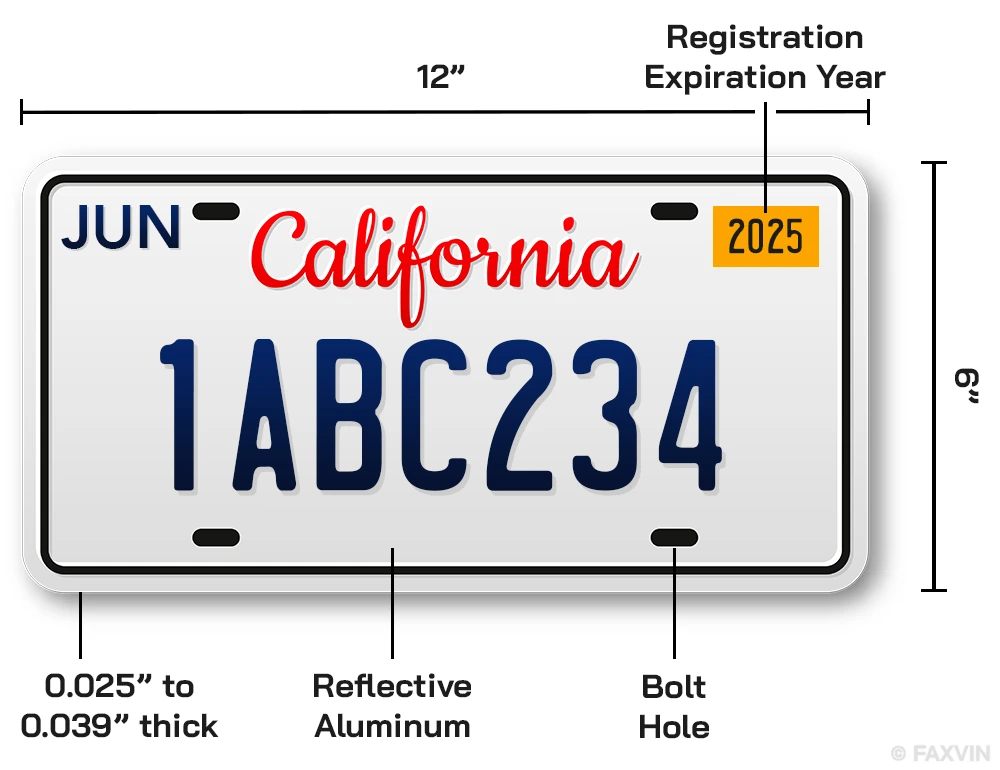
License plate designs are unique to each state, with slogans, landmarks, specialty backgrounds, and sticker placement to reflect local culture and history. Formats also vary from state to state, and larger states often use 7-character combinations, while smaller states use 5 or 6-character combinations. Passenger vehicles use 12 by 6-inch plates, but what gets printed where and what gets stuck where changes a lot.
Photos with license plates are not always easy to read and frames, bolt heads, glare, and busy designs can make characters harder to read: O vs 0, I vs 1, B vs 8. Also, watch the corners. Many states use small registration stickers for a month and year, and a plate frame can hide them. Missing stickers are not always a scandal, but they are a cue to look closer.
Front and Rear Plates
Some states require both front and rear license plates (CA, TX, NY, ...) while others require only a rear plate (FL, PA, OH, ...). If the ad shows the rear license plate only and the state requires two, ask for a picture of the front.
Types of License Plates
Each state issues several plate types, and here are the main ones:
- Standard – a default tag design installed on most vehicles.
- Personalized – custom plates with a letter/number combination of the owner's choice.
- Specialty – themed plates (military, universities, causes, charities, and more).
- Disability – plates or placards for qualifying drivers, often associated with accessible parking rules.
Temporary & Dealer Tags
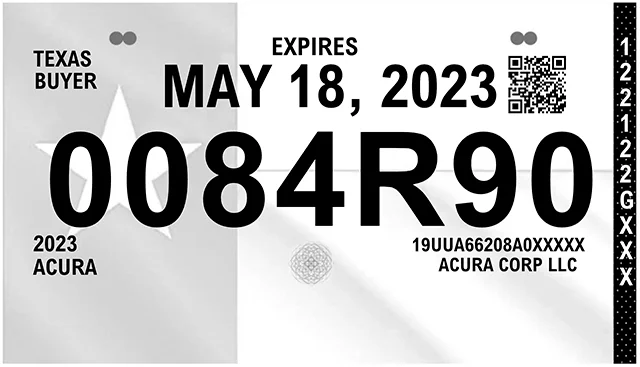
Temporary and dealer tags are issued until regular license plates are produced. They can be found on new vehicles purchased from a dealer, recent sales, title transfers, and vehicles awaiting registration.
The license plate must be clearly readable, up to date and placed in the same spot as a regular license plate.
Can You Find the Owner of a Car by License Plate?
Short answer – no. You can't look up a car owner by plate just because you're curious. That doesn't mean it can't be done. It means the license plate owner lookup can be authorized in cases when there are insurance claims, legal actions, or law enforcement activities in place. In all other instances, the personal information of the owner is protected by the Driver's Privacy Protection Act (DPPA).
Looking up a license plate through FAXVIN is not about finding out who owns this car, where they live, or how to contact them. Instead, you get valuable insight into the car's identity, title status, odometer records, lien signals and accident history.
License Plate Lookup by State
Many car owners treat license plates as unique fingerprints, but in reality, a plate number can be duplicated in different states. Simply put, if you want to get the most accurate data, you need to do a dedicated state license plate search.
Choose the state to run a license plate check and learn critical facts about the vehicle:
How to Run a License Plate Lookup
Running a plate check with FAXVIN takes no more than 10 seconds:
- Find the license plate number on the vehicle or registration.
- Select your state from the drop down.
- Type the plate number in the search box.
- Click "Check Plate" to view the basic information (VIN, make, model, engine, year).
- Order a full report if you need more information: accident history, branded titles, odometer issues, stolen records, and liens.
Frequently Asked Questions
Can I get a vehicle history using a license plate number?
Is FAXVIN plate lookup free to use?
Is it legal to look up a license plate?
Can I find out the owner of a license plate?
Why does my license plate show as "not found"?
Can a vehicle owner know if I checked their license plate?
Was this article helpful?